
When a factory emits carbon dioxide, the costs fall on people who never agreed to pay them. Environmental economics calls this a negative externality. The field's core solution is to price that damage directly, either through a carbon tax or a cap-and-trade system, at a level matching the estimated social cost of carbon.
On this page
- The idea in plain words: pollution is an externality
- The number: the social cost of carbon
- Two tools to set the price: tax vs. cap-and-trade
- A carbon tax sets the price
- Cap-and-trade sets the quantity
- A worked comparison: same goal, different certainties
- Where the disagreement really lives: the discount rate
- What this means for the policy you'll actually see
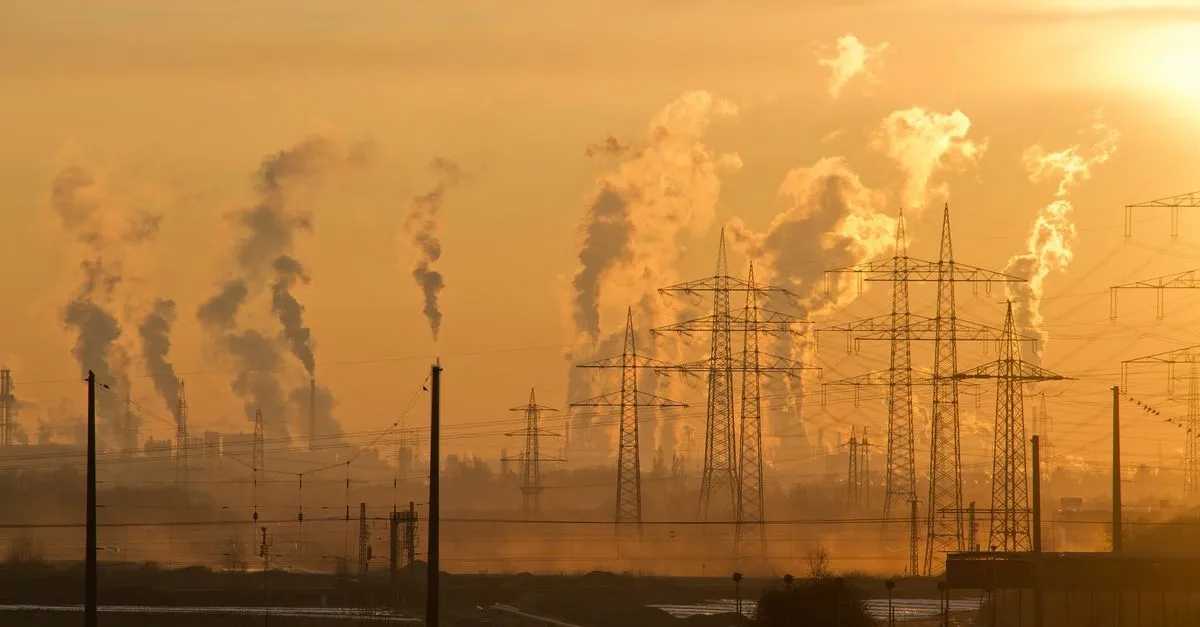
A power plant burns coal and sells electricity. The buyer pays for the power. But the carbon dioxide going up the stack imposes costs on coastal cities facing higher seas, on farmers facing worse droughts, on people decades from now, and those costs appear on no one's bill. The plant doesn't pay for them. Neither does the customer. That gap, between the private cost of an activity and its full cost to society, is the central problem of environmental economics. And the entire field's answer can be compressed into a single move: put a price on the thing that's currently free to dump. The question is how, and how high.
The idea in plain words: pollution is an externality
Economists call carbon emissions a negative externality, a cost imposed on third parties who are not part of the transaction. When a producer doesn't bear the full cost of what they produce, the market overproduces it, because the price buyers see is artificially low.1 Carbon is the textbook case: the atmosphere is a shared sink with no owner and no price, so emitting into it is free to the emitter and costly to everyone. Left alone, the market will pump out more CO2 than is socially optimal, not from malice, but because the price signal is missing the damage.
The fix follows logically. If the problem is that a cost is missing from the price, the solution is to put it back in, to make the emitter internalize the externality by attaching a price to each ton of carbon equal to the harm it does. Do that, and the market's own machinery does the rest: high-carbon activities get more expensive, low-carbon alternatives get relatively cheaper, and emissions fall to roughly the level where the benefit of one more ton equals its cost. The hard part is the number.
The number: the social cost of carbon
To price carbon, you first have to estimate what a ton of it actually costs society. That estimate is the social cost of carbon (SCC), the monetary value of the future stream of damages from emitting one additional ton of CO2 today. The EPA's 2023 Report on the Social Cost of Greenhouse Gases puts the central estimate at roughly $190 per ton of CO2 (for 2020 emissions, using a 2 percent discount rate), reflecting updated climate science and economic modeling.2 That figure is doing enormous work: it converts an abstract environmental harm into a dollar number that can be plugged into a tax rate, a regulation's cost-benefit analysis, or a permit price. If a ton of carbon costs society $190, then an efficient policy makes emitters face something near that $190, no more, no less.
The SCC is not a single agreed fact; it is a modeled estimate, and the modeling choices matter enormously, as the next section shows.
Two tools to set the price: tax vs. cap-and-trade
There are two main instruments for putting a price on carbon, and the difference between them is one of the cleanest illustrations of a core economic trade-off.
A carbon tax sets the price
A carbon tax charges emitters a fixed amount, say $190, per ton of CO2. The government sets the price directly; the quantity of emissions then adjusts as firms and households respond. The appeal is price certainty: businesses know exactly what carbon costs and can plan investments around it, and the policy is administratively simple. The downside is quantity uncertainty: you don't know in advance how much emissions will actually fall, because that depends on how responsive the economy turns out to be. If you need to hit a specific emissions target by a specific year, a tax gets you there only approximately.
Cap-and-trade sets the quantity
Cap-and-trade flips the levers. The government sets a hard cap on total emissions, issues that many permits, and lets firms buy and sell them. The market then discovers the price of a permit. The appeal is quantity certainty: the cap guarantees the emissions outcome. The trade-off is price volatility: the permit price can swing with the economy, spiking in a boom, collapsing in a recession, which makes long-term planning harder. The mechanism is efficient in a deep way, though: firms that can cut emissions cheaply do so and sell their spare permits; firms for whom cutting is expensive buy permits instead. Reductions happen wherever they are cheapest, which is exactly what you want.4
The symmetry is the whole point: a tax fixes price and lets quantity float; cap-and-trade fixes quantity and lets price float. Neither dominates, and the right choice depends on whether you care more about hitting an emissions target or about giving the economy a predictable price.
A worked comparison: same goal, different certainties
Imagine a region that emits 100 million tons of CO2 a year and wants to cut that meaningfully, with the SCC pegged at $190/ton.
Carbon-tax path. The government levies $190 per ton. Firms with cheap abatement options, such as switching fuels or improving efficiency, cut emissions because doing so is now cheaper than paying the tax. Firms facing expensive cuts pay the tax instead. Suppose emissions fall to 78 million tons. The result: a known price ($190), an unknown-in-advance quantity (it landed at 78M, but could have been 85M or 70M). The government also collects revenue on every remaining ton, about $14.8 billion, which can be rebated to households or used to cut other taxes.
Cap-and-trade path. The government instead sets a cap of 78 million tons and issues 78 million permits. Firms bid for them. If abatement is harder than expected, permit prices rise, perhaps to $230; if easier, they fall to $150. The result: a known quantity (exactly 78M, guaranteed by the cap) and an unknown-in-advance price.
Notice the two paths can reach the same emissions outcome, but one guaranteed the price and the other guaranteed the quantity. That is the trade-off in concrete form. The kind of measurement that tells policymakers which lever actually delivered comes from tracking energy-related CO2 emissions over time.5
Where the disagreement really lives: the discount rate
Most climate-policy fights look like arguments about science. Underneath, a startling share of them are arguments about a single number in the SCC calculation: the discount rate. Because carbon's damages land mostly in the future, you have to decide how much a dollar of harm decades from now is worth in today's terms. A higher discount rate treats future damage as worth less today, which shrinks the social cost of carbon and justifies weaker policy. A lower discount rate values future generations more heavily, which inflates the SCC and justifies aggressive action now. The swing is not small: moving the rate from 2 percent to 3 percent can cut the estimated social cost of carbon roughly in half, which is precisely why the EPA's choice of a 2 percent rate was itself a major policy decision.3 Two analysts who agree entirely on the climate science can reach opposite policy conclusions purely by disagreeing about how to weigh the future against the present. The discount rate is where ethics enters the math.
What this means for the policy you'll actually see
Strip away the slogans and almost every serious climate proposal reduces to two questions: what is a ton of carbon worth (the social cost of carbon, and the discount rate baked into it), and which lever do we pull to charge that price (a tax that fixes the cost, or a cap that fixes the quantity). That framework is the most useful thing environmental economics offers a non-specialist. When a carbon tax or an emissions-trading scheme is debated, you now know what to ask: Is the price near the estimated $190-per-ton damage, or far below it? Does the design prioritize a guaranteed emissions outcome or a predictable price? And what discount rate is doing the quiet work of deciding how much the future counts? Get those three questions answered and you understand the policy better than most of the people arguing about it, because you can see the economic skeleton beneath the political fight.
◆ Frequently Asked Questions
What is the social cost of carbon?
What is the difference between a carbon tax and cap-and-trade?
Why does the discount rate matter so much in climate policy?
What is a negative externality?
◆ Sources
- Externalities — Concise Encyclopedia of Economics, Library of Economics and Liberty
- Report on the Social Cost of Greenhouse Gases (2023) — U.S. Environmental Protection Agency
- Report on the Social Cost of Greenhouse Gases: Estimates Incorporating Recent Scientific Advances (Science Inventory record) — U.S. Environmental Protection Agency
- Carbon Pricing 101 — Resources for the Future
- Energy-Related Carbon Dioxide Emissions — U.S. Energy Information Administration