
A production function maps inputs to maximum possible output. When one input (typically capital) is fixed, adding more labor eventually yields smaller and smaller gains per worker: the law of diminishing marginal returns. Sustained growth comes not from adding more inputs but from shifting the production function upward through better equipment, organization, or technology.
On this page
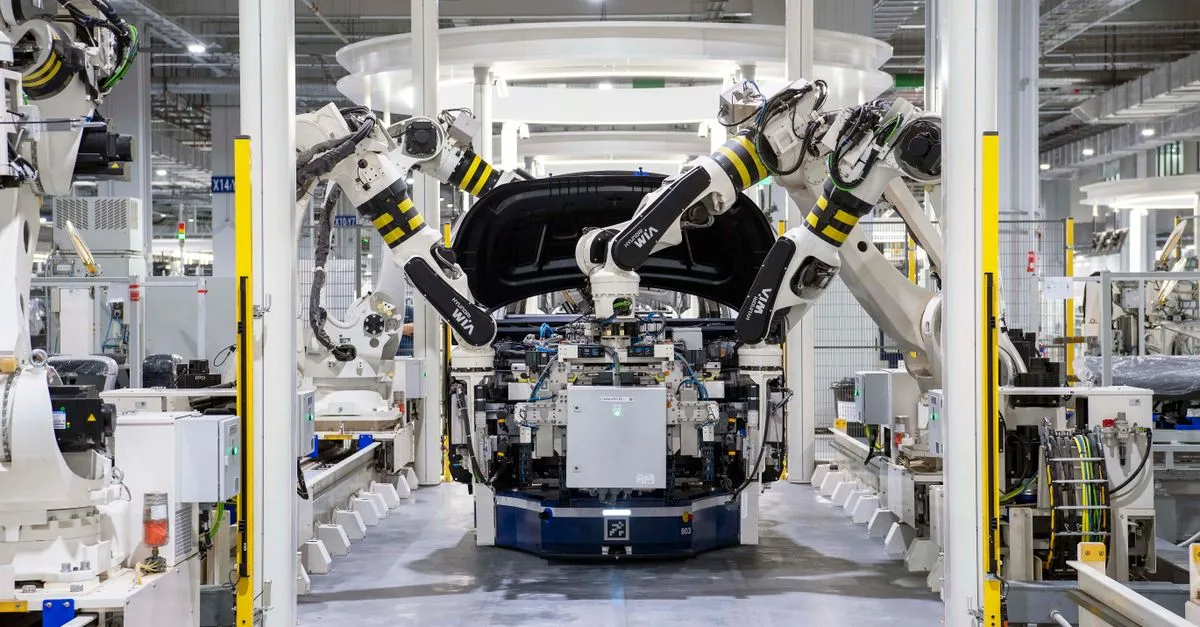
In the spring of 1914, Henry Ford's Highland Park plant employed roughly 13,000 workers and turned out about 300,000 Model T's per year. By 1916, with the moving assembly line fully running, the same basic footprint produced 585,000 cars with a workforce that had grown far less than the output had.1 Ford did not solve his capacity problem by hiring proportionally more workers. He redesigned the relationship between labor and capital, and the whole production curve shifted. That distinction, between adding more inputs to a fixed process and changing the process itself, is at the heart of what economists call the production function, and it reaches far beyond auto manufacturing.
How the machine actually works
Let's start with the core idea. A production function is the relationship that tells you the maximum output a firm can extract from any given bundle of inputs. Economists typically write output as a function of capital and labor, but the notation is secondary to the concept: for each combination of inputs, there is a best-case quantity of output, assuming the firm wastes nothing. As the Concise Encyclopedia of Economics frames it, this input-output relationship sits at the center of how economies convert effort and equipment into goods and services.2
The crucial distinction is between inputs that can change quickly and inputs that cannot. In the short run, at least one input is fixed, typically capital: the building, the machines, the oven. A firm can schedule extra workers for tomorrow's shift far faster than it can build a second factory. So in the short run, the firm adjusts output mainly by varying labor against a fixed stock of capital. That single constraint is what generates the central result.
The kitchen, quantified
Consider a commercial kitchen with one oven, fixed in place, and a single cook. Add a second cook and output jumps: one preps while the other bakes, and the dead time between batches shrinks. Add a third and you still gain, but a little less; now there is some waiting for oven space. By the time you have crowded eight cooks around one oven, the newest hire is mostly standing in someone's way. Output is still technically higher than with seven, but barely. The ninth cook actually reduces total meals because the kitchen is too congested.
This is the law of diminishing marginal returns in a concrete form: as you add successive units of a variable input to a fixed input, the additional output from each new unit eventually declines. Note the word eventually. Early additions can actually raise output by increasing amounts, as specialization kicks in, before the inevitable turn.
Here is that kitchen with numbers. The oven is fixed; cooks vary.
| Cooks | Total meals/day | Marginal product (extra meals from the last cook) |
|---|---|---|
| 1 | 20 | 20 |
| 2 | 46 | 26 |
| 3 | 78 | 32 |
| 4 | 104 | 26 |
| 5 | 124 | 20 |
| 6 | 138 | 14 |
| 7 | 146 | 8 |
| 8 | 149 | 3 |
| 9 | 147 | -2 |
Read the right-hand column. The marginal product rises through the third cook, as teamwork and specialization pay off, then falls from the fourth onward. By the ninth cook it goes negative: total output actually drops. Every cook is equally skilled and works just as hard. The decline is purely mechanical: a fixed oven can only bake so much, so each additional worker has less capital to work with. Diminishing returns is a property of the fixed input, not the variable one.
What the data shows
Diminishing returns is why you cannot read a factory's potential off its headcount alone, and why economists separate "more inputs" from "more productivity." The U.S. Bureau of Labor Statistics tracks labor productivity (output per hour worked) precisely to isolate how much more an economy produces per unit of effort, rather than just in total.3 When productivity rises, it generally is not because firms crammed more workers around the same machines. It is because the production function itself shifted upward.
The Federal Reserve's monthly G.17 release reinforces the same point from a different angle. It reports not just how much factories produce, but how close they are running to their sustainable capacity.4 When capacity utilization climbs into the high 70s or low 80s as a percentage of sustainable output, firms are deep in the diminishing-returns region of their short-run production functions. Squeezing out more at that stage gets expensive fast, and that is exactly when you expect investment in new plant rather than simply more shifts.
Shifting the whole function: where growth actually comes from
If adding labor to fixed capital runs into a wall, how do firms and whole economies produce vastly more over time? The answer is to move the entire production function upward, getting more output from the same inputs. Three forces do that work.
The first is capital deepening: giving each worker more or better equipment. A second oven changes the table above completely. Suddenly those crowded cooks have somewhere to go, and the diminishing-returns ceiling rises.
The second is better methods and organization. The division of labor that Adam Smith made famous, where breaking production into specialized tasks multiplies output, is the clearest historical example. The Concise Encyclopedia of Economics describes how splitting a job into specialized steps can raise output per worker by orders of magnitude, a pattern visible from 18th-century pin factories to modern assembly lines.5 Ford's moving assembly line was this principle operating at industrial scale.
The third, and over the long run the most powerful, is technological progress: genuinely new ways of producing. This is the residual that economists since Robert Solow have found accounts for the bulk of long-run growth in output per worker, beyond what added capital and labor alone explain.6 Sustained increases in living standards trace overwhelmingly to rising productivity, not to simply throwing more inputs at production.
The FRED database's industrial production series captures this shift in aggregate terms: the U.S. economy manufactures far more real output today with roughly the same number of production workers as in 1990, because each hour of labor operates against a vastly more capable stock of capital and technology.7
Now shift to where this hits your wallet
This is not abstract machinery. The production function is why your employer can only get so far by asking the existing team to do more. At some point the marginal product of another late night collapses, and real gains require investment in tools, training, or systems. It is why a successful restaurant adds a second location rather than squeezing more tables into a packed dining room. And at the level of the whole economy, it is why wages over the long run track productivity: workers earn more when each hour of their labor produces more, and each hour produces more chiefly when the production function shifts up, not when the workforce simply grows.6
The tenth cook in a one-oven kitchen and the tenth engineer on an under-equipped team are facing the same iron logic. Recognizing it tells you where the real lever sits: not more hands on the same machine, but a better machine for the hands you already have. The question worth asking about any organization stuck on a plateau is not "who else can we add?" but "what constraint are we all running into?"
◆ Frequently Asked Questions
What is a production function in simple terms?
What does diminishing marginal returns mean?
How do firms and economies grow if adding inputs runs into a wall?
Why does this matter outside of economics class?
◆ Sources
- Ford Motor Company: The Moving Assembly Line — Henry Ford Heritage Association
- Productivity — The Concise Encyclopedia of Economics, Library of Economics and Liberty
- Productivity — U.S. Bureau of Labor Statistics
- Industrial Production and Capacity Utilization (G.17) — Federal Reserve
- Division of Labor — The Concise Encyclopedia of Economics, Library of Economics and Liberty
- Economic Growth — The Concise Encyclopedia of Economics, Library of Economics and Liberty
- Industrial Production Index (INDPRO) — FRED, Federal Reserve Bank of St. Louis