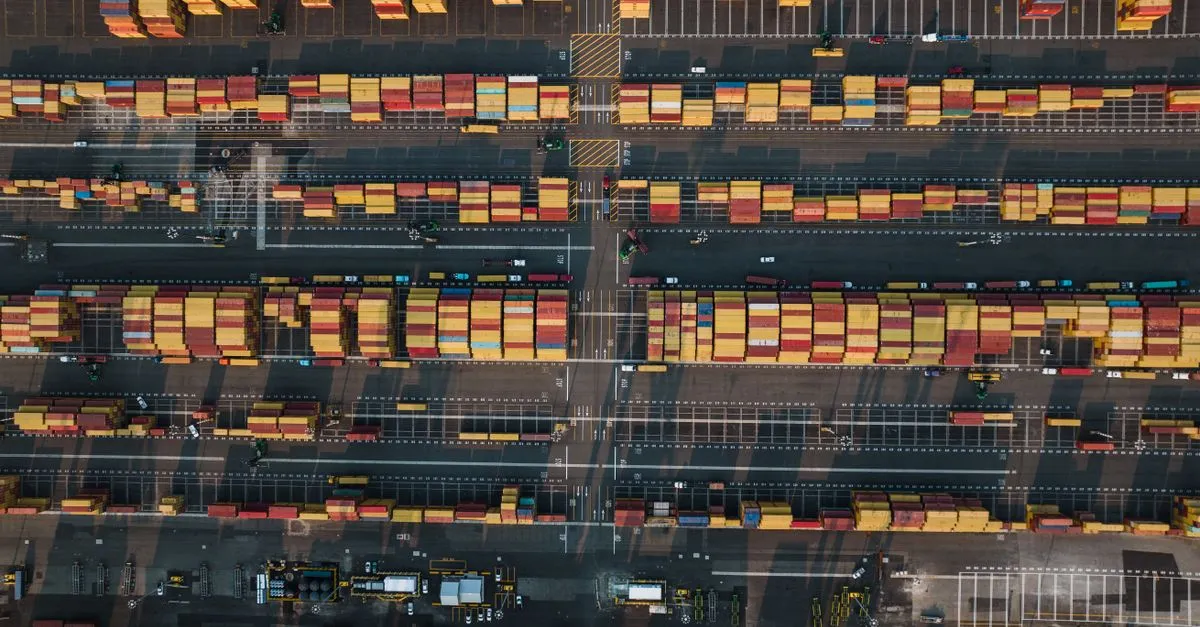

A tariff is a tax on imports that raises prices for everyone in the domestic market, not just on foreign goods. Domestic producers and the government collect gains, but consumers lose more than the winners gain combined. The gap between total losses and total gains is deadweight loss: value that simply disappears and helps no one.
On this page
When a country slaps a tariff on imported steel, the headline usually frames it as a fight between two nations: us versus them, our workers versus their factories. The accounting that actually matters happens entirely inside the importing country, and it is a fight among neighbors: domestic steelmakers and the national treasury on one side, and every consumer and steel-using manufacturer on the other. The striking result, which holds up across two centuries of analysis, is that the winners' gains never fully cover the losers' losses. The shortfall has a name, and almost no political speech mentions it.
What a tariff actually is
A tariff is a tax a government places on imported goods. As the Library of Economics and Liberty explains, its immediate effect is to raise the price of the imported good in the domestic market.1 That higher price is the lever that produces every downstream consequence. Domestic producers, who compete with imports, can now charge more and sell more. The government collects the tax on whatever still gets imported. And consumers pay the higher price on everything they buy, foreign or domestic.
Crucially, a tariff raises the price of the domestic version too. If imported steel suddenly costs more, domestic mills face less price pressure and quietly raise their own prices toward the new ceiling. So even buyers who switch to American steel to avoid the tariff still pay more. This is why the burden is so much broader than the tariff revenue suggests: the revenue is collected only on imports, but the price increase lands on the entire market.
The Numbers Breakdown: four boxes from one tax
Let us put real arithmetic on it. Imagine the U.S. market for a commodity widget. At the free-trade world price of $10, Americans buy 100 million widgets a year; domestic firms supply 40 million of them and the other 60 million are imported.
Now the government imposes a $3 tariff per widget, pushing the domestic price to $13. Two things move. Higher prices choke off some demand, so total purchases fall from 100 million to, say, 90 million. And the higher price coaxes domestic firms to ramp up, so home production rises from 40 million to 55 million. Imports get squeezed from both ends: 90 − 55 = 35 million imported, down from 60 million.
Here are the four boxes the tariff creates.
Box 1: Consumer loss. Every one of the 90 million widgets still bought now costs $3 more. That's a transfer of $270 million on the units still sold, plus the lost value of the 10 million widgets people no longer buy at all. Measured properly as lost consumer surplus, the total hit to consumers is roughly $285 million (the $3 × 90 million transfer plus half of $3 × 10 million in foregone purchases).
Box 2: Producer gain. Domestic firms now receive $13 instead of $10 on their output, and they sell more of it. Their gain in producer surplus is about $3 × 40 million plus part of the new output, roughly $142.5 million (the $3 markup on the original 40 million, plus half of $3 on the 15 million expansion).
Box 3: Government revenue. The Treasury collects $3 on each of the 35 million widgets still imported: $3 × 35 million = $105 million.
Box 4: Deadweight loss. Add up who got what. Consumers lost ~$285 million. Producers gained ~$142.5 million. The government gained $105 million. That leaves $285 − $142.5 − $105 = $37.5 million that nobody captured. It did not transfer to anyone: it vanished.
That $37.5 million is deadweight loss, and it comes from two distinct inefficiencies, visualized as two triangles. The production triangle is the waste from making 15 million extra widgets at home that the world could have supplied for $10, pulling domestic resources into a job they do less efficiently. The consumption triangle is the value lost on the 10 million widgets where mutually beneficial trades simply never happened because the price got too high. Neither shows up as anyone's gain. Both are pure subtraction from the economy.
Who wins, who loses
The boxes name the players precisely.
Winners: domestic import-competing producers and their workers. They get higher prices, more sales, and more jobs in that specific industry. Their gains are concentrated, visible, and easy to photograph: a reopened mill, a hiring announcement. This is why tariffs are politically attractive, because the beneficiaries know exactly who they are and lobby accordingly. The Library of Economics and Liberty's entry on protectionism emphasizes that this concentration of benefits, against diffuse costs, is the central political economy of trade barriers.2
Winners: the government, which pockets the tariff revenue, though only on the shrinking volume of imports that survive the tax.
Losers: consumers and downstream industries. A steel tariff helps steelmakers but raises costs for every company that uses steel: automakers, appliance manufacturers, construction. Those industries employ far more people than steel production itself, so a tariff defending one sector can cost jobs across several others. The losses are spread thin across millions of buyers, each paying a little more, which is exactly why they rarely organize to fight back.
What the real-world evidence shows
The theory predicts consumers eat most of the cost. The natural test is whether foreign exporters cut their prices to absorb the tariff, or whether the full tax shows up in U.S. prices. The wave of U.S. tariffs imposed in 2018-2019 became a giant natural experiment, and the U.S. International Trade Commission's economic analysis of those Section 232 and 301 tariffs found that the duties were passed through almost entirely to U.S. prices, meaning American importers and consumers bore nearly the full burden, while foreign exporters' prices barely moved.3 The Office of the U.S. Trade Representative's record of those Section 301 actions documents the scope; the price data shows who paid.4
That result is the deadweight-loss story made concrete: the tariff did not extract money from China so much as it taxed American buyers and reshuffled it among domestic producers and the Treasury, minus the slice that disappeared.
So why do countries ever impose them?
None of this means tariffs are always wrong. There are arguments outside the efficiency math. A country may want domestic capacity in steel, semiconductors, or medicines for national security, accepting an economic cost to avoid depending on a rival in a crisis. There is the infant-industry argument, temporarily shielding a young sector until it can compete, though history shows the shields rarely come off. And tariffs are a tool of retaliation and leverage in negotiations, a way to bring a partner to the table even if the tariff itself is costly. The World Trade Organization's framework on tariffs exists precisely to bind and reduce these barriers by mutual agreement, recognizing that one country's tariff invites another's.5
But these are exceptions argued on non-economic grounds. On the pure economics, the verdict has been stable since Ricardo: a tariff helps a visible few, costs an invisible many more, and burns a little value in the process that helps no one at all. The next time a tariff is sold as a costless win against a foreign rival, count the boxes. The money mostly moves between your own neighbors, and some of it just goes up in smoke.
◆ Frequently Asked Questions
Who actually pays a tariff?
What is deadweight loss and why does it matter?
If tariffs hurt consumers, why do governments impose them?
Does a tariff on imported goods raise the price of domestic versions too?
◆ Sources
- Tariffs — Library of Economics and Liberty (Concise Encyclopedia of Economics)
- Protectionism — Library of Economics and Liberty (Concise Encyclopedia of Economics)
- Economic Impact of Section 232 and 301 Tariffs on U.S. Industries — U.S. International Trade Commission (Publication 5405)
- Section 301 Investigations — Office of the U.S. Trade Representative
- Tariffs and Other Import Barriers — World Trade Organization